
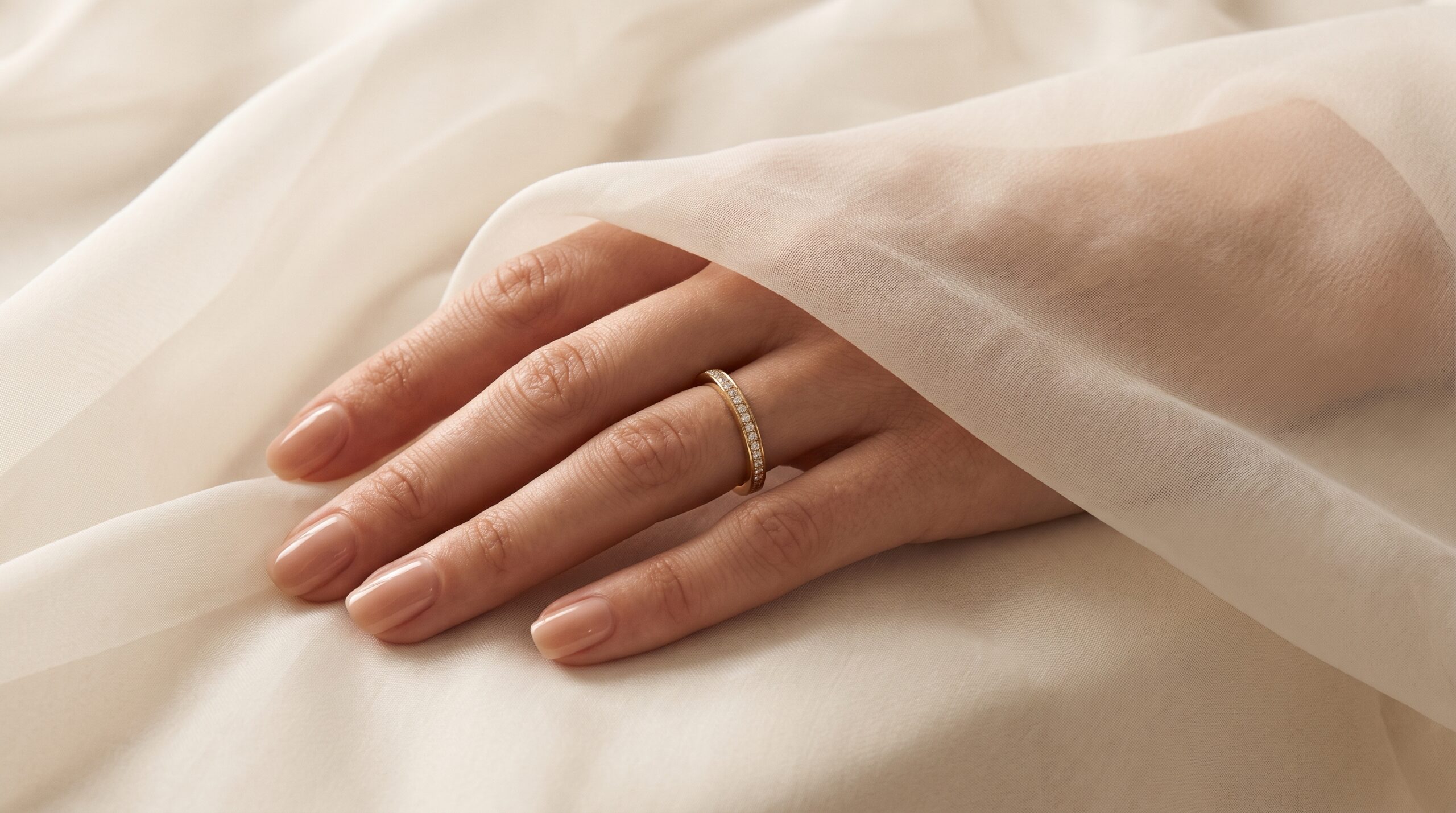
Most couples spend weeks or months choosing an engagement ring, then treat the wedding band as an afterthought. That’s backwards in one important way: the wedding band is the ring worn every single day, through showers, workouts, dishwashing, and decades of ordinary life. The engagement ring might come off for certain activities. The wedding band usually doesn’t.
That daily-wear reality raises questions engagement ring shopping doesn’t. Which metal actually holds up to constant contact? Does the band need to match the engagement ring exactly, or just complement it? Is a diamond band practical for someone who works with their hands? What width is comfortable versus what just looks good in a photo?
This guide walks through those decisions in order: styles, metals, width and fit, matching an existing engagement ring, durability, and the maintenance a ring actually needs once it’s on your hand for good.
What Is a Wedding Band?
Traditional Meaning and Modern Role
A wedding band is the ring exchanged during a wedding ceremony, worn afterward as a continuous symbol of marriage. Unlike an engagement ring, which is typically given before the wedding and often features a center stone, a wedding band is usually simpler in design and intended for uninterrupted daily wear on the same finger for the rest of the wearer’s life.
That difference in purpose changes what matters in the purchase. An engagement ring is chosen partly for the moment of the proposal. A wedding band is chosen for thousands of ordinary days afterward: typing, lifting, gardening, swimming, sleeping. Comfort and durability carry more weight here than they do for a ring that might come off more often.
Common Wedding Band Types
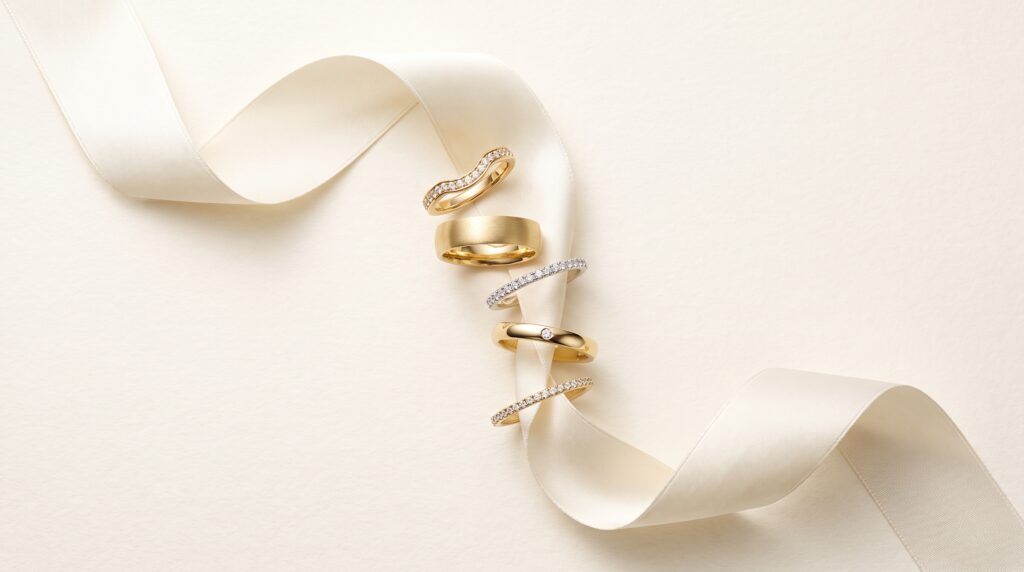
Plain metal bands are a single continuous piece of metal with no stones, sometimes finished with a brushed, matte, or hammered texture instead of a plain polish.
Diamond bands set stones partway around the ring, usually across the top or front-facing portion, leaving the back of the band plain metal.
Eternity bands set diamonds or other stones continuously around the entire circumference, with no plain metal section.
Contour bands are shaped with a curve or notch that follows the outline of a specific engagement ring, so the two rings sit flush against each other instead of leaving a visible gap.
Stackable bands are thinner rings, often sold in sets, meant to be worn together in a cluster rather than as a single band.
How to Choose the Right Wedding Band
Start With Lifestyle and Daily Wear
The honest starting point isn’t style, it’s what your hands actually do all day. Someone who works construction, cooks professionally, plays a contact sport, or lifts weights regularly will put more stress on a ring than someone whose job is mostly at a desk. That doesn’t rule out any particular style, but it changes the tradeoffs worth thinking through.
A few practical questions to sit with before shopping:
- Do you work with your hands, use tools, or handle equipment regularly?
- Do you go to the gym, and if so, do you typically remove rings before lifting?
- Does your job or hobby involve frequent handwashing, chemical exposure, or water?
- How much upkeep are you actually willing to do: occasional professional cleaning, or none at all?
None of these questions point to a single “correct” answer. They just narrow the range of styles and metals worth comparing.
Decide Between Plain or Diamond Styles
A plain metal band and a diamond-set band solve different problems, and the choice comes down to what you’re optimizing for.
Plain bands have fewer points of failure. There’s no stone to loosen, no prong to catch on fabric or bend against a hard surface, and resizing is straightforward because there’s no setting to disturb. Diamond bands add sparkle and can echo the stones in an engagement ring, but they introduce maintenance: prongs wear down over time and need periodic inspection, and resizing a diamond-set band is more involved than resizing a plain one, sometimes not possible at all if the stones run the full circumference.
| Plain Metal Band | Diamond Band | |
| Sparkle | None | Visible, front-facing or full circumference |
| Daily durability | High, few points of failure | Moderate, depends on setting security |
| Maintenance | Minimal | Periodic prong inspection recommended |
| Resizing | Straightforward | More limited, depends on how far stones extend |
| Best for | Hands-on jobs, low-maintenance preference | Buyers who want the band to echo an engagement ring’s sparkle |
Neither is objectively better. A surgeon who scrubs in multiple times a day and a jeweler who wants maximum sparkle for a special-occasion band are optimizing for different things, and both choices are reasonable within their own context.
Understanding Wedding Band Metals
Platinum vs White Gold
Platinum and white gold look nearly identical at a glance, but they behave differently over years of wear. Platinum used in fine jewelry is typically about 95 percent pure, alloyed with metals like iridium or ruthenium, and it’s naturally white, so it never needs replating. White gold is gold alloyed with white metals such as palladium or nickel, then coated with a thin layer of rhodium to achieve its bright white finish. That rhodium layer wears down with friction over time and needs periodic professional replating to keep the ring looking white rather than slightly yellow underneath, according to <cite index=”4-1,4-4″>a GIA-trained gemologist’s comparison of the two metals</cite>.
The two metals also scratch differently. <cite index=”4-3″>Gold, and 14K gold in particular, tends to show fewer surface scratches than platinum under similar conditions, but a gold scratch represents actual metal loss from the surface</cite>. <cite index=”4-3″>Platinum, being denser and more ductile, displaces rather than loses metal when scratched, which is why it develops a soft matte patina over time instead of visibly thinning</cite>. In practical terms: platinum tends to preserve more of its original metal weight over decades, while gold shows fewer scratches day to day but wears away in tiny amounts each time it’s marked.
Platinum is also the more hypoallergenic option, since it contains no nickel, which makes it a common recommendation for anyone with a known metal sensitivity. Platinum generally costs more than white gold for an equivalent ring, both because it’s rarer and because it’s denser, so a ring of the same size uses more metal by weight. The GIA’s guide to choosing a white metal covers the tradeoffs in more depth.
Yellow Gold vs Rose Gold
Yellow and rose gold are both gold alloyed with other metals for strength and color, not separate base metals. Yellow gold uses alloys like silver and copper to reinforce pure gold while keeping its warm tone close to natural. Rose gold uses a higher proportion of copper in the alloy, which shifts the color toward pink. Because rose gold’s copper content also adds hardness, it tends to be somewhat more scratch-resistant than yellow gold at the same karat.
Neither requires the periodic rhodium replating that white gold does, since there’s no white plating layer to wear off. Karat purity works the same way across all gold colors: 24K is pure gold and too soft for daily-wear rings, so jewelry is typically sold in 18K (75 percent gold), 14K (58.3 percent gold), or occasionally 10K (41.7 percent gold), with the remaining percentage made up of alloy metals that add hardness. A lower karat is generally more scratch-resistant for everyday wear, which is part of why 14K is a common choice for wedding bands specifically, even though 18K has a richer color and higher gold content.
Alternative Metals
Tungsten, titanium, and cobalt chrome have become common in men’s wedding bands, largely because they’re significantly harder than precious metals and resist scratching well. The tradeoff is that most of these metals can’t be resized in the traditional sense, since they don’t bend or stretch the way gold and platinum do; some can crack under enough force rather than dent. They’re generally less expensive than precious metals and, being newer to fine jewelry, don’t carry the same resale or heirloom value.
| Metal | Durability | Maintenance | Weight | Typical Price Range | Resizable |
| Platinum | High, patinas rather than wears away | Low | Heavy | Highest | Yes |
| 14K White Gold | Moderate-high | Rhodium replating every 1-2 years | Moderate | High | Yes |
| Yellow/Rose Gold | Moderate-high, depends on karat | Low | Moderate | Moderate-high | Yes |
| Tungsten/Titanium | Very scratch-resistant, can crack under force | Very low | Varies | Lower | Usually not |
Anyone with a known nickel allergy should ask specifically about alloy composition rather than assuming a metal is safe based on color or price; the FTC’s guidance on buying platinum, gold, and silver jewelry explains how these metals are legally required to be marked and disclosed.
Wedding Band Width and Fit Guide
Common Width Ranges Explained
Wedding bands are typically sold in millimeter widths, most commonly ranging from about 2mm to 8mm or wider. A 2mm band is thin and delicate, often chosen to sit close to an engagement ring without adding visual bulk. A 4mm band is a common middle ground, noticeable but not dominant. A 6mm band reads as a more substantial, deliberate presence on the hand, common for men’s bands or for anyone who wants the ring to be a clear visual statement. Widths of 8mm and above are bold and best suited to larger fingers, where a narrower band can look disproportionately thin.
Comfort Fit vs Standard Fit
The difference is in the interior shape of the band, not the outside. A standard-fit band has a flat interior, with sharp edges where the flat inner surface meets the outer curve of the ring. A comfort-fit band has a rounded, slightly domed interior that curves outward, so less metal surface actually touches the finger at any given point.
That rounded interior means a comfort-fit ring in your measured size will typically feel slightly looser than a standard-fit ring in the same size, because it doesn’t grip the finger with a flat surface the way a standard-fit band does. Many jewelers size comfort-fit rings a half size down from a standard-fit measurement for this reason. The practical effect is a ring that’s easier to slide on and off and generally more comfortable over a full day of wear, particularly for wider bands where a flat interior would otherwise press against more of the finger.
How Width Affects Comfort and Appearance
Wider bands cover more of the finger’s surface, which means they’re more likely to need a comfort-fit interior to feel good over a full day. Wider bands also sit higher and can affect how a ring stacks against an engagement ring; a very wide wedding band next to a delicate engagement ring can look mismatched in scale, while a very thin band next to a bold engagement ring can look undersized by comparison. Finger proportions matter too: a wide band on a narrower finger takes up more of the visible finger length, while the same width on a larger hand reads as more balanced.
| Width | Visual Appearance | Comfort Consideration | Best For |
| 2mm | Delicate, minimal | Comfortable at any fit type | Stacking, narrow fingers, subtle presence |
| 4mm | Balanced, noticeable | Comfort-fit optional but common | Most day-to-day wear |
| 6mm | Substantial | Comfort-fit interior recommended | Larger fingers, bolder style preference |
| 8mm+ | Bold, statement | Comfort-fit interior strongly recommended | Larger hands, deliberate visual weight |
Matching a Wedding Band to an Engagement Ring
Why Metal Matching Matters
Different white metals have subtly different tones. Platinum has a cool, slightly gray-white cast. White gold, even freshly rhodium-plated, can carry a faint warmth depending on the alloy. Worn side by side for years, a platinum band and a white gold engagement ring will age differently, since the platinum develops a patina while the white gold’s rhodium plating gradually wears thin and needs replating to stay bright. Matching metals isn’t strictly necessary, since many people wear a mix intentionally, but pairing the same metal keeps the color relationship stable over time rather than letting one ring’s finish visibly diverge from the other’s.
Flush Fit vs Gaps
A straight wedding band next to a rounded engagement ring setting will often leave a small gap where the two rings don’t quite meet, because the engagement ring’s curve pulls away from the flat edge of the band. Whether that gap matters is a matter of preference: some people don’t notice or mind it, others want the two rings to sit as one continuous line.
When Contour Bands Are Necessary
A contour band solves the gap problem by shaping the wedding band’s inner edge to follow the outline of a specific engagement ring, notching or curving around the setting so the two rings nest together without a visible space. Contour bands are typically made to match a particular engagement ring style rather than sold as a universal fit, so they work best when purchased with the engagement ring’s design in mind, sometimes from the same designer or after the band is custom-fitted to the existing ring.
Matching Diamond Styles and Proportions
If the engagement ring has a halo, pavé shoulders, or a particular diamond cut, a wedding band that echoes the same stone size and setting style will generally look more cohesive than one with a noticeably different diamond shape or size. This is a matter of visual proportion rather than a fixed rule: a plain band next to a heavily set engagement ring can also look intentional and clean by contrast, rather than mismatched.
Wedding Band Durability and Long-Term Wear
What Makes a Band Durable?
Three factors matter most: metal thickness, alloy composition, and setting security. A thicker band has more metal to wear through before it becomes structurally thin, which matters most for rings worn every day for decades. Alloy composition affects hardness, which is why 14K gold, with a higher proportion of hardening alloy metals than 18K, tends to hold up better against everyday scratching. For diamond or eternity bands, setting security depends on how well the prongs or channel hold the stones in place, and that can wear down with friction and impact regardless of how hard the metal itself is.
Bands That Require More Maintenance
Pavé settings, where small diamonds are held by tiny shared prongs across the band’s surface, are more prone to snagging and prong wear than larger single-stone settings, simply because there are more prongs and each one is smaller and more delicate. Eternity bands carry the same consideration around their entire circumference rather than just the front. Ultra-thin bands, generally under about 2mm, are more prone to bending out of round over years of wear, particularly with repeated impact against hard surfaces.
Resizing Considerations
Full eternity bands, where stones run the entire circumference, are difficult or sometimes impossible to resize without disturbing the stone setting, since resizing typically involves cutting and rejoining a section of plain metal that a full eternity band doesn’t have. A half eternity band, with stones across the front and plain metal at the back, can usually be resized through that plain back section the way a standard band can.
Finger size isn’t fixed over a lifetime. Weight changes, pregnancy-related swelling, and normal age-related changes in joint size are all common reasons people resize a wedding band years after the original purchase, and it’s worth asking a jeweler about resizing policy and cost before buying, particularly for eternity or heavily set styles.
Wedding Band Care and Maintenance
Cleaning Recommendations
<cite index=”27-3″>A basic cleaning solution of warm water and a drop or two of mild dishwashing detergent, with a soak of about 20 minutes followed by gentle scrubbing with a soft-bristled brush, is a widely recommended approach for most gemstone and metal combinations</cite>, according to the American Gem Society. <cite index=”27-3″>Harsh chemicals like chlorine or bleach should be avoided</cite>, and porous or soft stones need gentler handling than diamonds do.
Professional Inspections
Prongs wear down gradually with friction, and a stone that feels secure can loosen well before it’s visibly obvious. An annual professional inspection is a reasonable baseline for a diamond-set band, and more frequent for pieces worn constantly through manual work or exercise.
Storage Best Practices
Store rings separately rather than piled together in a single tray or box; metal-on-metal contact between pieces causes scratching over time, even between two rings made of the same material. A fabric-lined compartment or individual soft pouch reduces that contact, and keeping jewelry away from direct sunlight and humidity, such as a bathroom counter, helps slow tarnishing on metals that are prone to it.
When to Remove Your Ring
Rings are generally better off during activities involving direct chemical exposure, heavy impact, or extreme temperature change: swimming in chlorinated or salt water, applying lotion or sunscreen, heavy lifting or contact sports, and certain manual trades. This isn’t about babying the ring; it’s about avoiding the specific conditions that cause disproportionate wear compared to ordinary daily use.
Quick care checklist:
- Clean with mild soap and warm water on a regular basis, not just when visibly dirty
- Get a professional prong and setting inspection at least once a year for diamond or gemstone bands
- Store rings separately, away from direct sunlight and bathroom humidity
- Remove rings before swimming, heavy lifting, and applying lotions or sunscreen directly to the hands
Buying a Wedding Band Online
Product Details Buyers Should Look For
A trustworthy online listing should specify exact metal purity (platinum fineness or gold karat), band width in millimeters, band thickness, and setting details for any stones, rather than vague descriptions like “premium metal” or “brilliant diamonds.” Real photography of the actual product, ideally from multiple angles and in natural lighting, matters more than rendered or stock images when judging finish and proportions. <cite index=”12-2″>Marketers are required to describe or mark platinum according to the actual percentage of pure platinum in the piece, and gold jewelry should carry a karat quality mark along with the trademark of the company standing behind that mark</cite>, per FTC guidance.
Red Flags to Avoid
Listings that rely entirely on stock or rendered imagery instead of photographs of the actual product being sold are worth extra scrutiny. So is any listing that’s vague about metal purity, for example describing a ring as “gold” or “platinum” without a karat or fineness marking. Missing or unclear information about resizing policy, especially for eternity or heavily set bands, is another signal to ask more questions before buying.
Questions to Ask Before Purchasing
- What is the exact metal purity, and is it disclosed with a specific karat or fineness number rather than a general description?
- Is the band resizable, and what does resizing cost or involve for this specific style?
- What’s the return and exchange policy if the fit or style doesn’t work once it arrives?
- Are the product photos of the actual item, or stock images representing the style generally?
- What warranty or maintenance program, if any, comes with the purchase?
Final Thoughts
The best wedding band isn’t the most expensive one or the one that photographs best. It’s the one that fits how you actually live: comfortable enough that you stop noticing it’s there, durable enough to handle what your hands do every day, and proportioned in a way that feels right against an engagement ring if you’re wearing one. Comfort-fit construction, the right width for your finger and lifestyle, and a metal that matches your maintenance tolerance matter more day to day than trend-driven design choices.
If you’re still deciding between a few finalists, try them on and wear them around a store for a few minutes rather than judging from a photo. A ring that looks right in a case can feel different after ten minutes on your hand, and that’s closer to what the next several decades will actually feel like.
Frequently Asked Questions
Should my wedding band match my engagement ring?
Not necessarily. Matching metal tone keeps the color relationship stable over years of wear, since different metals age differently, but plenty of couples intentionally mix metals or styles. If the two rings will be worn stacked together daily, a contour band or metal match tends to look more cohesive, but a deliberate contrast can also look intentional rather than mismatched. It comes down to personal style rather than a fixed rule.
What wedding band width is most comfortable?
There’s no single answer, since comfort depends on finger size, lifestyle, and whether the band has a comfort-fit interior. A narrower band, generally 2mm to 4mm, tends to feel unobtrusive for most people, while wider bands of 6mm or more usually need a comfort-fit interior to avoid feeling bulky over a full day. The best way to judge is trying on the actual width in person rather than estimating from a product photo.
Are eternity bands practical for everyday wear?
They can be, but they come with tradeoffs worth knowing before buying. Because stones run the entire circumference, eternity bands are difficult or sometimes impossible to resize without disturbing the setting, and every point around the ring carries the same maintenance considerations that a partial diamond band only has along the front. A half eternity band, with plain metal at the back, keeps some of the sparkle while remaining easier to resize.
Can wedding bands be resized?
Most plain metal bands in gold or platinum can be resized within a reasonable range by a jeweler. Diamond bands are more limited, and full eternity bands often can’t be resized at all without removing or resetting stones. Alternative metals like tungsten and titanium generally can’t be resized in the traditional sense, since they don’t bend the way precious metals do. It’s worth asking about resizing policy and cost before purchasing, particularly for anyone whose finger size has changed in the past or might change in the future.
Is platinum better than gold?
Neither is objectively better; they suit different priorities. Platinum is denser, naturally white without needing replating, and generally considered the more hypoallergenic option since it contains no nickel. Gold, particularly 14K, tends to show fewer surface scratches day to day and costs less, though white gold needs periodic rhodium replating to stay bright. The <cite index=”4-1″>choice comes down to budget, maintenance tolerance, and whether the natural white color and minimal upkeep of platinum are worth the higher price</cite>.
Do men’s wedding bands need to be thicker?
Not as a rule, though men’s bands are statistically more likely to be worn during physical work or exercise, which is part of why wider, more substantial widths are common. The right width depends on finger size, comfort preference, and daily activity level rather than gender specifically. A hands-on job or frequent gym use is a better guide to width and metal choice than convention alone.
How often should wedding bands be cleaned?
A regular at-home cleaning with mild soap and warm water, done every week or two rather than only when the ring looks visibly dull, keeps oils and residue from building up in settings and along the band’s surface. Professional cleaning and inspection on top of that, at least once a year for diamond-set bands, catches prong wear and loose stones before they become bigger problems.
What’s the difference between comfort-fit and standard-fit?
The interior shape. Standard-fit bands have a flat interior with sharp inner edges, while comfort-fit bands have a rounded, domed interior that curves outward and reduces the amount of metal surface pressing against the finger at any point. Comfort-fit rings in a given size typically feel slightly looser than standard-fit rings in the same measured size, which is why many jewelers size them a half size down. The difference matters most for wider bands, where a flat interior has more surface area in contact with the finger.