
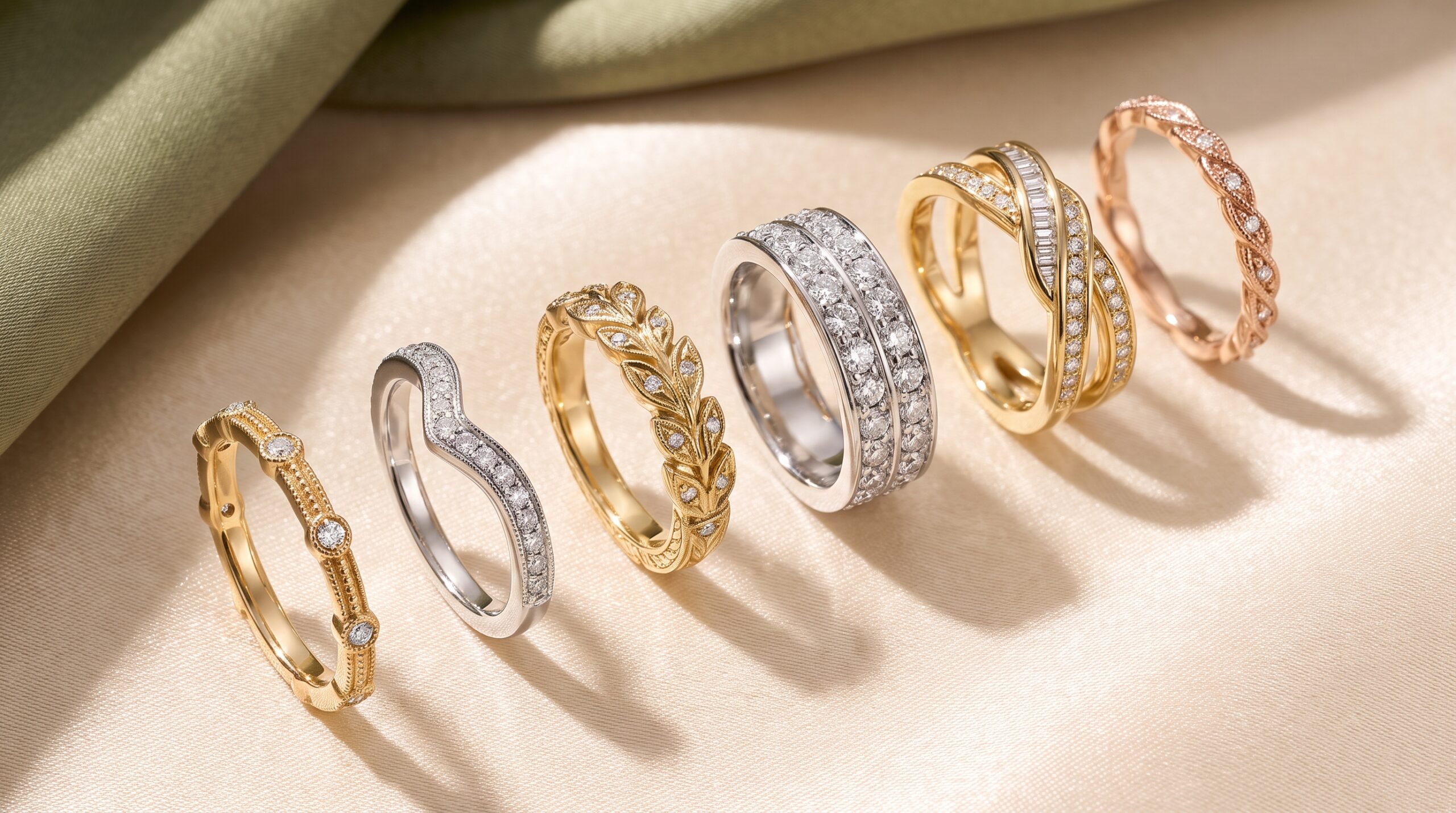
A vintage wedding band carries something a brand-new ring can’t replicate: decades of design history compressed into a single object, plus (if it’s authentic) the specific hand of a jeweler who worked before mass production standardized most of what’s sold today. That’s the appeal. The hesitation that usually follows is practical: is it sturdy enough to wear every day, how do you know it’s what the listing says it is, and can it even be resized if your finger doesn’t match whatever size it happens to be.
Those are reasonable questions, and they have concrete answers once you understand a few things about how vintage jewelry is categorized, how different eras were built, and what to check before you commit to buying one.
What Is a Vintage Wedding Band?
The terms “vintage,” “antique,” and “vintage-inspired” get used loosely in jewelry marketing, but they mean different things. Antique typically refers to a piece that’s 100 years old or older. Vintage generally covers roughly 20 to 99 years old, a wide range that includes everything from mid-century Retro styles to pieces made in the 1990s. Vintage-inspired describes a modern ring designed to evoke an older era’s aesthetic without actually being from that period; it’s a new piece built to look old, not an old piece.
| Type | Age | Original Era Piece? | Typical Buyer Appeal |
| Antique | 100+ years | Yes | Historical rarity, direct connection to a past era |
| Vintage | 20-99 years | Yes | Distinctive design, character, more available than antiques |
| Vintage-inspired | New | No | Era aesthetic with modern construction and resizing flexibility |
None of the three is inherently better than the others. An authentic vintage piece offers history and individuality that a reproduction can’t claim, while a vintage-inspired ring offers the same visual language with more predictable durability and easier resizing. The right choice depends on how much you value the actual age of the piece versus the practicality of a new build.
What draws most buyers to genuine vintage and antique bands isn’t just aesthetics. It’s the sense of individuality that comes from wearing something that wasn’t mass-produced, the visible hand-craftsmanship common in pre-industrial jewelry-making, and for many couples, the heirloom quality of owning a piece with its own history before it became theirs. Wedding rings themselves have a documented history stretching back thousands of years, and GIA’s overview of wedding ring origins traces that symbolism from ancient Egypt through to modern practice, which is part of why an older ring can feel connected to something larger than a single purchase.
Understanding Popular Vintage Wedding Band Eras
Victorian wedding bands (roughly 1837 to 1901) tend to feature floral motifs, romantic symbolism like hearts, bows, and serpents, and warm yellow gold as the dominant metal. Colored gemstones show up frequently, often chosen for symbolic meaning rather than pure sparkle. Victorian pieces vary widely in construction quality, since the era spans over 60 years of changing techniques, so structural condition needs individual evaluation more than era alone can tell you.
Edwardian wedding bands (roughly 1901 to 1915) shifted toward platinum, which had recently become workable for fine jewelry, and introduced delicate filigree work resembling lace rendered in metal. The look is airy and intricate, often with small diamonds set into openwork patterns. That same delicacy is the era’s main practical trade-off: fine filigree is more prone to bending or catching than thicker, simpler designs, which matters if the ring will see daily hands-on wear.
Art Deco wedding bands (roughly 1915 to 1935) moved toward geometric styling, bold symmetrical lines, and a more architectural sensibility overall, often in platinum or white gold. Structurally, Art Deco pieces tend to hold up better to daily wear than Edwardian filigree, since the design language favored cleaner, sturdier lines over delicate open lattice work.
Retro wedding bands (roughly 1935 to 1950s) brought chunkier proportions, milgrain detailing (a beaded metal edge technique), and simpler gemstone work than the eras before it. The overall look reads as more playful and substantial, and the sturdier construction typical of this period tends to hold up reasonably well to regular wear.
| Era | Design Traits | Typical Metals | Durability | Best For |
| Victorian | Floral motifs, romantic symbolism, colored stones | Yellow gold | Varies widely by piece | Warm, romantic aesthetic |
| Edwardian | Filigree, lace-like openwork, delicate detail | Platinum | Lower, due to fine open metalwork | Ornate style, lower-impact wear |
| Art Deco | Geometric lines, symmetry, bold structure | Platinum, white gold | Higher | Daily wear with a distinctive look |
| Retro | Chunkier proportions, milgrain, playful detail | Gold, platinum | Moderate to high | Substantial, everyday-friendly style |
How to Evaluate a Vintage Wedding Band Before Buying
Structural integrity comes first. Check the prong condition if the ring holds a stone, since worn or thinned prongs are a common failure point in older pieces. Look at stone security directly rather than assuming it’s fine; a stone that shifts slightly when touched needs attention before the ring sees daily wear. Examine the band for thin spots, particularly on the underside, where decades of contact and prior resizing can wear metal thinner than it started. Ask about repair history directly, since a well-repaired vintage piece is often a better daily-wear choice than an untouched one with visible wear the seller hasn’t disclosed.
Hallmarks and provenance work like a ring’s identity stamp. A metal purity stamp (10K, 14K, 18K, Pt950, and so on) confirms composition. A maker’s mark, when present, can sometimes be traced to a specific jeweler or workshop, adding both authenticity and, in some cases, value. A written appraisal or authenticity document from a qualified gemologist adds a layer of verification beyond the seller’s word, and it’s reasonable to ask whether one is available or can be arranged before purchase.
Craftsmanship quality shows up in details that are easy to check even without expertise: engraving that’s smooth and consistent rather than rough or uneven, symmetry in the overall design, stones that sit flush and aligned rather than slightly askew, and, if the piece has been restored, work that blends cleanly with the original rather than looking visibly patched.
Are Vintage Wedding Bands Durable Enough for Daily Wear?
It depends heavily on the era and the specific piece, more than on “vintage” as a category. Art Deco bands, built with structural simplicity and platinum’s inherent strength, generally hold up best to daily wear among the classic eras. Retro pieces, with their chunkier construction, also tend to wear reasonably well. Victorian bands vary considerably since the era covers decades of differing techniques and quality levels. Edwardian filigree, while some of the most visually striking vintage jewelry available, is the era most likely to need careful handling rather than rough daily use, given how fine and open the metalwork typically is.
A few factors matter more than era alone. Metal type affects baseline strength, with platinum generally outperforming early gold alloys and certainly outperforming silver, which was common in some 19th-century pieces and wears faster than either. Setting construction determines how securely stones stay in place over decades of wear. Gemstone security is worth checking regardless of era, since loose stones are a repair issue rather than an inherent flaw in the design. And filigree fragility is a real, specific risk: open lacework metal is more prone to bending or catching on fabric and hair than a solid band, which matters if you’re active with your hands throughout the day.
If your lifestyle involves frequent hands-on work, a vintage-inspired ring may be the more practical choice. You get the visual language of a given era, Art Deco geometry or Edwardian filigree detail, built with modern construction standards and typically full resizing flexibility, without the specific wear concerns that come with an actual decades-old piece.
| Style Era | Durability | Maintenance Needs | Best Lifestyle Match |
| Art Deco | Higher | Low to moderate | Daily wear, active hands |
| Retro | Moderate to high | Low to moderate | Daily wear |
| Victorian | Varies by piece | Moderate | Lower-impact wear, case-by-case evaluation |
| Edwardian (filigree) | Lower | Higher, careful handling | Special occasion or lower-impact daily wear |
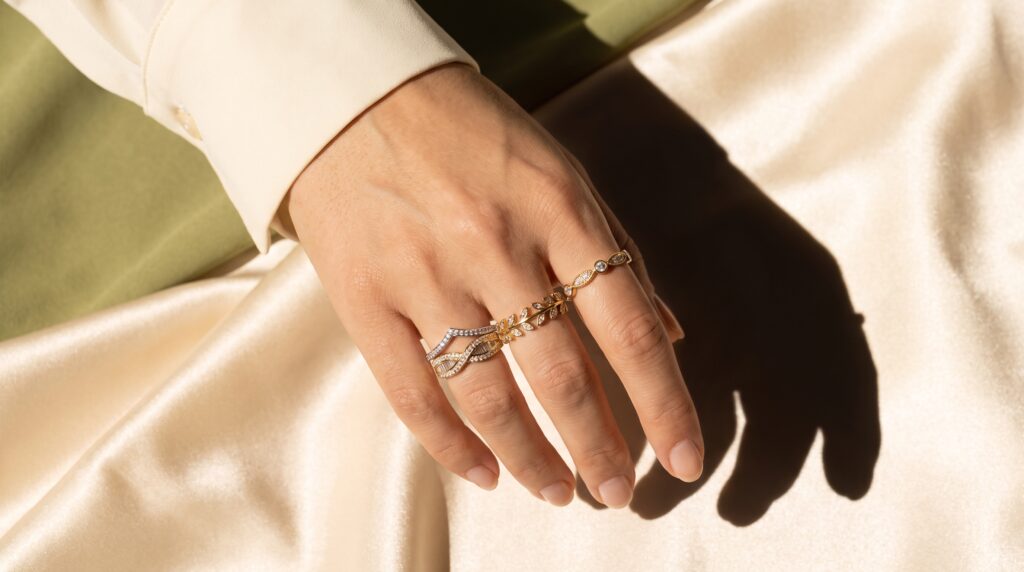
Choosing the Right Vintage Wedding Band for Your Style
Victorian and Edwardian styles suit buyers drawn to romantic, ornate aesthetics: floral detail and colored stones for Victorian, airy filigree and platinum for Edwardian. Art Deco suits buyers who want a bolder, more architectural look with strong geometric lines and better daily-wear durability than the eras before it. Retro and simpler vintage-inspired bands suit buyers who want a hint of vintage character without heavy ornamentation, a more understated way to reference an older design language.
If you’re matching a vintage band to an existing engagement ring, a few things matter beyond just picking a favorite era. Metal matching, pairing similar tones (platinum with platinum, yellow gold with yellow gold) creates visual cohesion, though deliberate mixed-metal pairings are increasingly common and not a mistake. Profile compatibility matters if the bands will be worn stacked together daily; a tall, ornate engagement ring setting next to a very simple band can look mismatched, while similar height and detail level tend to sit together more naturally. Width balance is worth considering too, since a very thin vintage band can look visually lost next to a substantial engagement ring, or vice versa.
Vintage Wedding Band Sizing and Resizing Considerations
Sizing carries more weight with vintage rings than with most modern ones, because the design and construction can limit what’s possible afterward. An engraved band, especially one with pattern work running the full circumference, can lose part of that engraving if resized, since resizing typically involves cutting and reshaping a section of the band. Eternity-style bands, with stones set continuously around the entire ring rather than just the top, are often difficult or impossible to resize without disturbing the stone settings. Fragile filigree work adds another layer of risk, since the resizing process itself can stress delicate open metalwork in ways a solid band wouldn’t experience.
Comfort and wearability come down to a few structural details specific to vintage construction. Width affects both look and feel, with wider vintage bands reading more substantial on the hand. Gallery structure, the open space beneath a stone setting, can affect how a ring sits against the finger and how easily it collects debris over time. Tapering, where a band narrows or widens along its circumference, is common in older designs and affects comfort differently than a uniform modern band.
Given these constraints, get a precise, professional sizing before committing to a vintage piece with engraving, eternity-style stone settings, or delicate filigree, since your resizing options may be limited or nonexistent once you own it.
Caring for a Vintage Wedding Band
Clean with mild soap and lukewarm water, using a soft brush for gentle contact rather than anything abrasive, and dry the ring thoroughly afterward rather than letting it air dry with moisture trapped near settings. Avoid ultrasonic cleaners on vintage pieces specifically, since the vibration can loosen stones that are already held by older, potentially worn prongs, a real risk that doesn’t apply the same way to sturdier modern settings. GIA’s jewelry care guidance recommends caution with ultrasonic cleaning for pieces with fracture-filled or specifically treated stones and for antique jewelry more broadly, since the method that’s perfectly safe for a modern, securely set diamond can be a real risk for an older piece. Avoid harsh chemicals, including household cleaners and chlorine, and store the ring in a way that prevents contact with other jewelry rather than tossing it loosely into a drawer.
Beyond routine cleaning, a yearly prong check by a jeweler catches loosening before it becomes a lost stone. Monitor wear patterns over time, particularly on the underside of the band where daily contact is heaviest. Periodic professional cleaning, done by someone experienced with vintage construction rather than standard modern methods, keeps the piece looking its best without introducing unnecessary risk.
What to Look for When Buying Vintage Wedding Bands Online
A trustworthy vintage listing should include visible hallmarks, disclosed repair history if any repairs have been made, stated metal purity, and clear disclosure of the actual era or approximate age rather than a vague “vintage-style” label used to imply age without committing to a claim. Visual documentation should go beyond a single polished photo: look for magnified close-ups that show engraving detail and wear condition, multiple angles or a 360-degree view, and a clear close-up of any hallmark stamp so you can verify it yourself rather than taking the description on faith.
Red flags include vague “antique” or “vintage” labeling with no specific era or age range given, no return policy (a reasonable expectation for a purchase this significant), and missing documentation on metal purity or stone details. The American Gem Society sets ethical and educational standards for member jewelers and is a reasonable resource to check if you’re looking for a dealer with recognized credentials in a specific market.
| What to Check | Why It Matters | Red Flag |
| Hallmark or metal stamp | Confirms basic material composition | No visible hallmark in photos or description |
| Stated era or age range | Distinguishes real vintage from vague marketing | “Vintage-style” language with no actual age claim |
| Repair history disclosure | Affects both value and durability expectations | No mention of repairs on a piece with visible wear |
| Magnified, multi-angle photos | Lets you assess condition yourself | Only one polished, well-lit photo |
| Return policy | Protects you if the piece doesn’t match its description | No return policy on a significant purchase |
Frequently Asked Questions
What is the difference between antique and vintage wedding bands?
Antique generally refers to a piece that’s 100 years old or older, while vintage covers a broader range, typically 20 to 99 years old. Both terms describe genuinely old pieces rather than new reproductions, which is where “vintage-inspired” comes in as a separate category for modern rings designed to look like an older era without actually being from that period.
Are vintage wedding bands safe for everyday wear?
It depends on the specific era and piece rather than being true across the board. Art Deco and Retro styles generally hold up well to daily wear due to their sturdier construction. Edwardian filigree, with its delicate open metalwork, tends to need more careful handling and may not be the best choice for hands-on daily use. Checking the individual piece’s structural condition matters more than relying on era alone.
Can vintage bands be resized?
Sometimes, but with real limitations depending on the design. Engraved bands can lose part of the pattern during resizing. Eternity-style bands, with stones set continuously around the band, are often difficult or impossible to resize without disturbing the settings. Simpler, solid bands without extensive engraving or full-circumference stone settings are generally the easiest vintage pieces to resize safely.
How can I tell if a vintage ring is authentic?
Check for a visible hallmark or metal purity stamp, ask whether repair history is disclosed, and look for detailed, magnified photos that let you assess condition and craftsmanship yourself rather than relying only on the seller’s description. A written appraisal from a qualified gemologist adds an additional layer of verification if you want more certainty before a significant purchase.
Which vintage era is most durable?
Art Deco pieces generally offer the strongest structural durability among the classic vintage eras, thanks to their cleaner, more geometric design language and frequent use of platinum. Retro pieces from the following decades also tend to wear well due to their sturdier, chunkier construction. Edwardian filigree, while often stunning, is the most delicate of the major eras due to its fine, open lacework metal.
Are vintage-inspired rings a good alternative?
Yes, particularly for buyers who love a specific era’s aesthetic but want more predictable durability and full resizing flexibility. A vintage-inspired ring is built new, with modern construction standards, to evoke an older design rather than to actually be one. It won’t carry the same history as an authentic piece, but it removes many of the structural uncertainties that come with jewelry that’s genuinely decades or a century old.